Jump to recipe for zucchini butter, tomato and cheese melt
Even though I’m not a student anymore, I still think of fall as back-to-school season. I live close to a major university, so thousands of students return to my city every August. At first, after I finished grad school, I didn’t envy them. I’d see undergrads picking out study snacks at Trader Joes and I’d think, “Aw, enjoy your close-reads of Kipling tonight you adorable nerds. I’m going to drink pumpkin-spiced wine and watch James Van Der Beek do a cha cha in an iridescent shirt unbuttoned to his navel on Dancing With the Stars. I’m a full Master of Fine Arts, so I earned it.”
But this fall, for the first time since I graduated, I’ve felt some nostalgia for my classroom days. It’s partly due to general nostalgia overdrive. I’m missing a lot of weird things right now, like public water fountains and condiment bars and the one Zumba instructor at my gym who always asked if we were “feelin’ sexy.” But, I also miss school because I’ve been reading and writing more lately — and I wish I had classmates to share it with.
In grad school, I spent many autumns in creative writing workshops. In a workshop, students spend most of their class time critiquing each others’ writing. The process can be stressful, but also rewarding. Most of the time, I genuinely enjoyed reading my classmates’ work. And I got used to them reviewing mine. Every time I turned in an essay, I got 14 copies of it back with contradictory notes scribbled in the margins. For example:
This cat essay has too much cat content. I want to know more about the passing of the narrator’s father and/or ficus.
And
This 20-page essay about seven cats should be twice as long and have more cats in it. I find the narrator boring in comparison to Rudy the spunky tabby: The true hero of this story.
The feedback wasn’t always positive or even clear. But, I appreciated that my peers took my work seriously and asked questions I didn’t expect. They always opened up new space inside my writing.
So today, in honor of this back-to-school season unlike any other, I’d like to invite you into a literary exploration. I’m going to talk about zucchini — not as a cook, but as a student. I want to dig into the vegetable’s deeper meaning. Sure, it’s green, bland and ubiquitous. That’s the situation. But what is it’s story? The following three-part essay attempts to answer that question.
If you would like to fully immerse yourself in the workshop experience, please type a one-page response, double-spaced. Describe at least one thing you appreciated about the work and one thing that could be improved. For extra credit/realism, be sure to write at least one weirdly personal, negative comment somewhere like, “curious lack of empathy.” Then, move on with your day while I think about it at least once a month, forever. It’ll be just like old times!
I look forward to your feedback.
I
I did not notice zucchini for the first decade of my life. That’s not to say it wasn’t present. It was the soggy chunks in vegetable soups and the green flecks in muffins and quick breads throughout my childhood. But, it was never the star of the meal, so I never bothered to form an opinion on it.
Then, one year, a single zucchini intruded into my life in a way I could not ignore. I was probably ll or 12 — on the cusp of coming of age as a woman.
Coincidence?
Yes, absolutely. It was 100% coincidence.
My father interviewed a local grower for his column in the city paper. I don’t remember why my dad was interested in the farmer, or the story his column told. I only consistently read my dad’s work when he mentioned me in it. However, I do remember how the farmer thanked my dad afterwards. It was with a gift of — and you may have guessed this already due to my expert foreshadowing — a truly humongous zucchini.
It’s not enough to say it was the biggest zucchini I’d ever seen. Normal, medium-sized zucchini were to this giant zucchini as normal-sized chickens are to Big Bird. I remember it having roughly the same girth as the Stanley cup, and weighing about as much as a dense four-year-old. Granted, it may have seemed bigger to me then because I was smaller, but I’m sure it was enormous even by adult standards. My parents didn’t know what to do with it at first, so they just put it in the garage. For weeks, every time we entered or exited the house, the monstrous vegetable loomed over us with ominous, green hugeness.
By the end of the October, It was becoming increasingly clear that the life of this abnormal vegetable could not come to a normal end. It wouldn’t simply be sliced, absent-mindedly during a phone chat with an out-of-town relative, then tossed into a stir-fry. No. Its death would require flare.
I think my mom chopped and froze part of it, and used one frisbee-sized slice to make zucchini bread. But after that, at least half of the zucchini was still left. And my parents happened to be throwing a Halloween party. The whole family helped decorate in preparation. We twisted black and orange crepe paper together and taped it across the dinning room ceiling, and we pulled store-bought cobwebs over the bushes outside.
Then someone — I don’t remember who — sunk our biggest butcher knife into the zucchini’s hide. Someone else suggested pouring ketchup around the entry wound. We placed the slain vegetable in the corner of the snack table, surrounded by chips, bars and plastic spiders.
It got a few bemused reactions at the party, but mostly people just reached across it to get to the salsa.
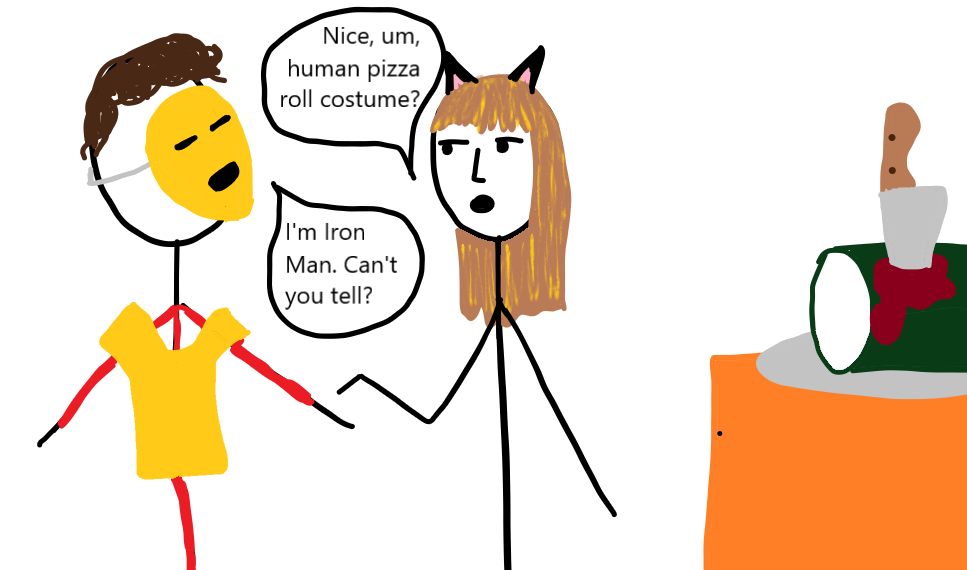
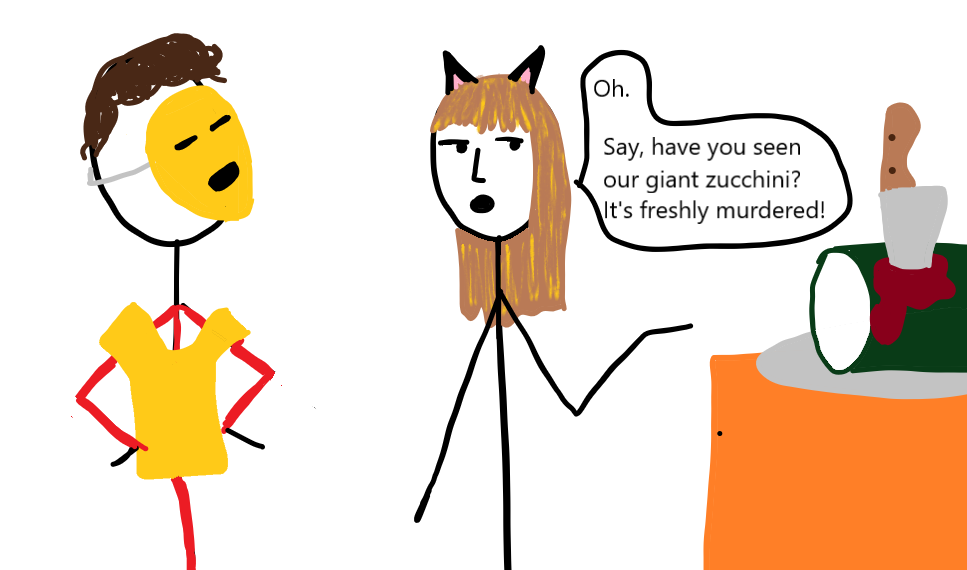
In the end, my parents effectively reinforced their dominance over their produce. The power balance in our house rocked back into its former equilibrium.
Except.
Except I didn’t know it then, but this would become one of the core memories of my youth. Again and again, I have told the story of how we murdered my father’s giant zucchini on All Hallows Eve. And I vividly remember the butchers knife, the ketchup, and the pale vortex of its severed belly.
In effect, I would never be able to ignore zucchini again.
II
Decades passed. I left home and developed a working relationship with zucchini. Every summer, the earth seemed to throw the squashes at me by the handful like Tootsie Rolls at a 4th of July parade. Zucchini appeared in heaps at the grocery store and on filing cabinets at work next to Post-its that said, “Please take!!!”. At my local farmers market, one vendor sold them ten for a dollar. I developed a small but reliable stable of zucchini recipes — more out of a sense of duty than enthusiasm. But then I returned to the kitchen of my childhood, and my relationship with zucchini transformed again.
This year, my mom bought a CSA share from a local farm. Every Tuesday, a waxy cardboard box arrives on her porch with an assortment of whatever vegetables are in season. During my recent Minnesota residency, I was tasked with finding recipes to utilize the produce. The unboxing was always thrilling. It reminded me of the anxious hope I felt as a kid, tearing grab bags open. Except, instead of fossilized Bit-O-Honeys and rubber finger puppets, there were rutabagas and bunches of kale inside.
And of course, zucchini.
One night, I announced that I wanted to bake something chocolate and gooey for dessert. “OK,” my mom said, “but you have to use the last of the zucchini in the fridge.” I sighed. I didn’t mind zucchini baked goods, but they often seem like glorified vessels for garbage vegetable disposal. If the biggest compliment you can pay a zucchini muffin is, “you can’t even taste the zucchini,” what’s the point?


Still, I agreed to my mother’s terms and found a recipe for zucchini brownies online. My mom had the right amount of zucchini to make a half-batch of the brownies, so I began to follow the straightforward instructions. When I poured the finished batter into the baking pan though, it didn’t look right. I couldn’t get it to spread evenly, and oil oozed around the sides.
I looked back over the recipe and realized immediately what I’d done wrong: I had halved all of the ingredients except the oil. Loosing track of your ingredient ratios is a relatively common error — for elementary-schoolers who haven’t learned fractions yet, or cartoon dogs in children’s books who are baking cake for the first time. Adult, human women should know better.
I told my mom what happened. “It was a rookie mistake,” I said sadly.
“You’re right,” she said. “it was.”
I thought through my options for saving the brownie batter. I had enough of all the ingredients to double the quantities and make a full batch — except the zucchini. Then, I recalled another vegetable from the CSA box that sometimes gets smuggled into baked goods: beets.
Some cursory internet research told me that I couldn’t simply grate the beets into the batter raw. I had to make a puree first. So, I peeled one large beet, diced it, simmered in a small pot of water until it was fork-tender, drained it and pureed it with an immersion blender. By the time all that was done, I was about an hour and a half into my “quick” post-dinner brownie bake. I added the puree to the batter with the rest of the ingredients and poured it into a new pan. This time, the consistency looked more like what I was expecting. I had no idea how the bars would bake though. There was nothing left to do but put them in the oven and wait.
When I pulled them out 40 minutes later, they looked and smelled encouragingly like brownies — not like cocoa powder mixed into Knorr vegetable dip, as I had feared. After they had cooled a bit, I cut two small pieces for me and my mom to sample and topped them with vanilla ice cream. I sat down at the table and took a bite.
I was shocked.
The brownies were incredible. They didn’t taste like vegetables, but the produce seemed to improve the texture somehow. They were perfectly fudgy in the middle with crisp, chewy edges.
As I ate, questions churned inside of me: Did the zucchini make the brownies good? Or, were the brownies good in spite of the zucchini? Would they have been as good without the beets? Which vegetable had the greater impact? Since these brownies have vitamins in them, can I cut them into granola bar shapes and eat them for breakfast?
My mom suggested that I do a series of experiments to get some answers. I could make one version with just zucchini and one with just beets, then compare the two. I said that sounded reasonable, but I didn’t think I would. I was comfortable dwelling in a shimmering state of zucchini mystery.
III
I told my mom as soon as I had the chance: “I saw two huge zucchini in the free zucchini bin today.”
I had her interest. She knew the free zucchini bin well. It materializes every summer, a few blocks away. Someone sets a wire basket in a chair on the sidewalk side of their front yard fence. Sporadically, enormous striped squashes appear in the basket, along with a cardboard sign that says “FREE ZUCCHINI.”
“So,” my mom asked, “you took one?”
“No, I couldn’t. I was running.”
“Oh,” she said, unable to hide her disappointment.
“Well, I thought you already had enough.”
“No, you’re right. It’s fine. We don’t need any more zucchini.”
We moved on with what had become our normal evening routine. My mom fed the cats, watered her plants and walked the dog. I prepared dinner. As we ate, the topic of zucchini came up again. I told my mom that one of my favorite ways to preserve zucchini is to make zucchini butter: You cook shredded zucchini in butter and olive oil until it’s caramelized and jammy. It’s great with eggs and on sandwiches.
“I think I’ve made that before too,” my mom said. “It’s good. Too bad we don’t have enough zucchini to make some now.”
“Yeah,” I said. “Too bad.”
We chewed silently
My mom spoke again. “I mean, that free zucchini is probably gone by now anyway.”
“Yeah,” I said. “Probably.”
We cleared the table. Darkness deepened outside. My mom loaded the dishwasher and I watched from the kitchen doorway, arms folded. I looked over at where Sidney, my mom’s geriatric black lab, was sleeping.
“Do you think Sidney could walk to the zucchini house, or is that too far for her?” I asked. Sidney had developed arthritis and a pronounced limp in her old age, and her usual walk route was only about two blocks long.
“No, she could probably walk that far…” I could see my mom wondering where I was going with this.
“Well, I was thinking. It would be crazy to go and get that zucchini now, at nine o’ clock at night.”
“Yes, it would…”
“…But say we took the dog for a walk, and we just happened to pass by the free zucchini. Then if, say, we very casually took one, it wouldn’t be weird at all.”
“Oh,” my mom said, now understanding the full scope of my elaborate plan to abscond with a zucchini very clearly marked, FREE ZUCCHINI. “Yes. Let’s do it”
So, we pulled on our jackets, clipped Sidney’s leash onto her collar, and stole out into the night. When we got to the zucchini house, we discovered that — miraculously — both zucchinis were still in the bin.
“Which one should I take?” I asked.
“Both!” my mom said, a little too quickly.
“Both?”
“No, no. Of course not.” My mom regained her composure. “That would be insane. Just take the smaller one.”
“Are you sure? Because they’re both free. It says so right here.”
“Yes, I’m sure. We should leave one for someone else.”
I grabbed the smaller of the two vegetables, and we headed home. If any of my mom’s neighbors watched us leave the neighborhood with a limping dog that night, and then saw the American Girl doll-sized vegetable tucked under my arm upon our return, they made no mention of it to us.
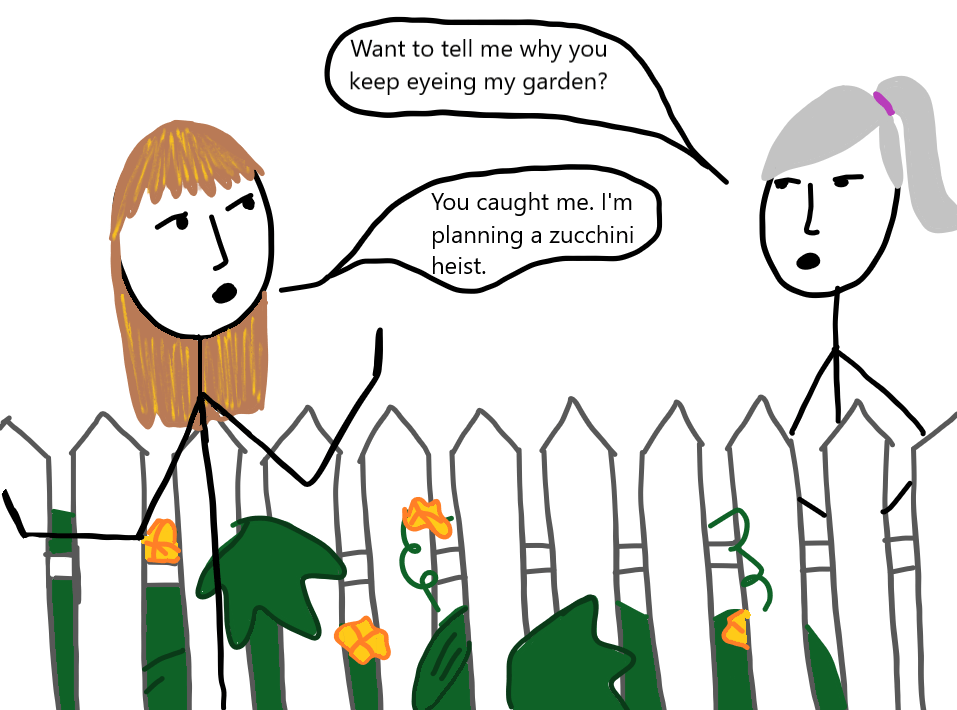
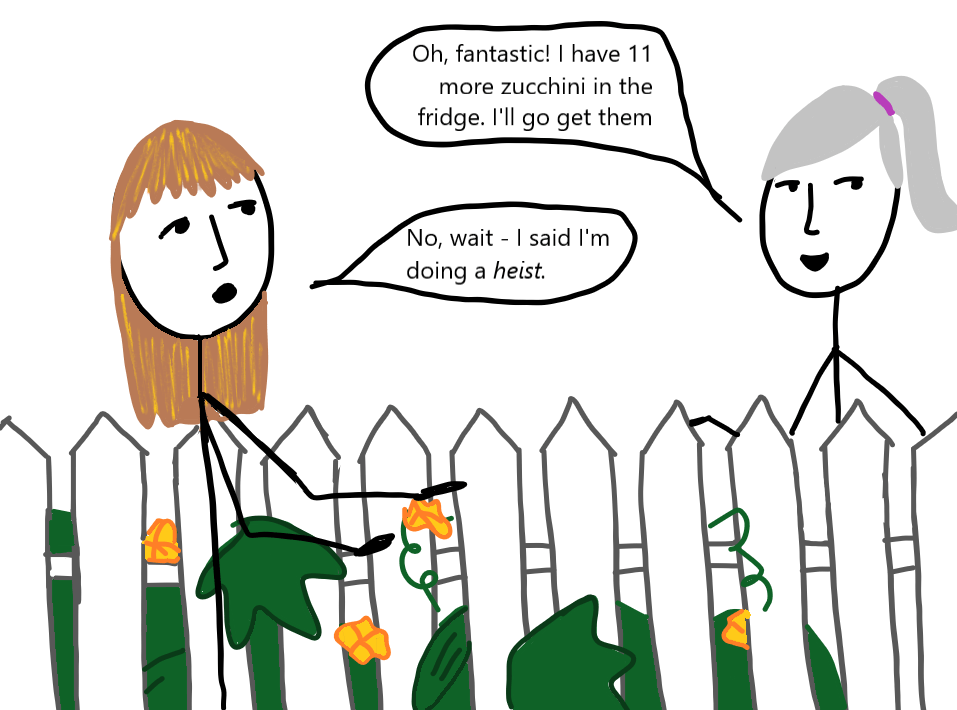
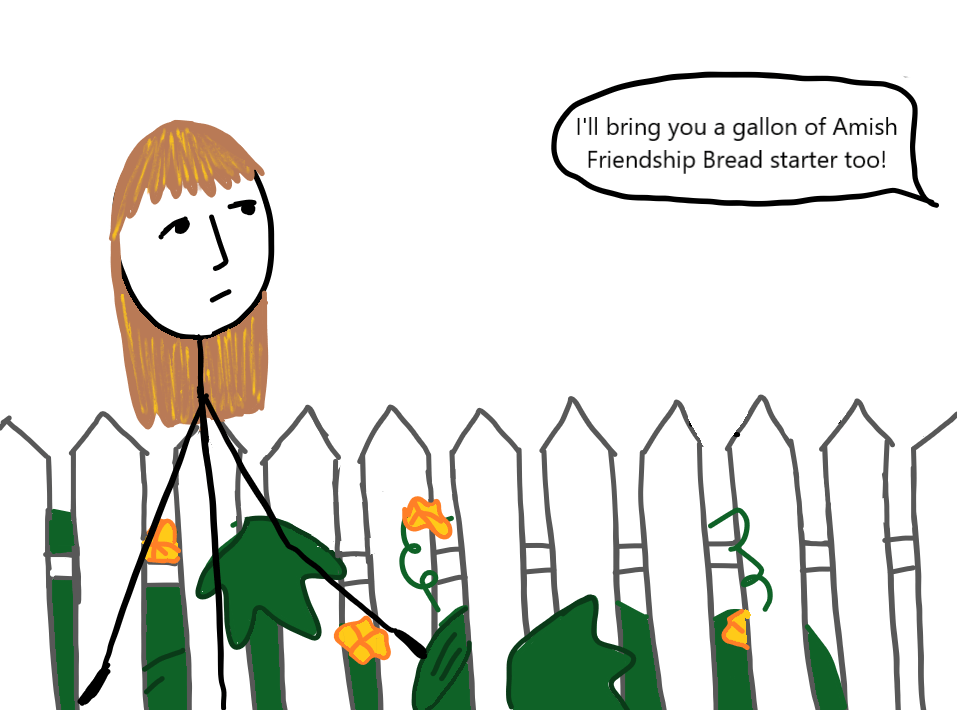
The next day, my mom went for a run. When she came back she told me that she had passed the free zucchini bin. The second zucchini was gone.
The End?
What meaning can I draw from these three scenes, tracing my arc from zucchini-indifferent girl to adult zucchini zealot? In the end, I do not think that zucchini itself can bear the full weight of my transformation. The vegetable is merely a canvas onto which I have painted my insecurities and desires. It tastes like nothing, so I can add it to anything. It can be appetizer, entrée or dessert. It is both a jubilant reminder of earth’s bounty, and an oppressive symbol of excess-induced claustrophobia. (It can’t be pasta though. I draw the line at zoodles, you guys.)
Perhaps zucchini is a metaphor for metaphors.
Or, perhaps zucchini is simply a constant. It has always has always been with me, and I know it always will be. It is I who have changed.
The next time you’re confronted with a zucchini, you might consider what it means to you. Or what you mean to it. Or, you could just put it in some cake and eat it like a normal person. Up to you! Regardless, there are some zucchini recipes on the next page: one for zucchini butter, and one for an open-faced brunch sandwich you can use it on. I know zucchini season has passed. But, if you still have some of summer’s bounty in your fridge — weighing on your heart and mind — this is a great way to preserve it for a few more weeks.


I may have to murder a (little) zucchini!
LikeLike