Jump to recipe for rhubarb custard popsicles
For a long time, I thought my lab career had peaked in the seventh grade. My science project that year was entitled, “What is the Most Important Ingredient in a Cake?” I baked Betty Crocker’s yellow cake recipe ten times – each time omitting a different ingredient. I evaluated the finished cakes with a rubric that included height, color, texture and taste.
It wasn’t my highest-scoring science project. Late the night before it was due, I covered my tri-fold board with jagged, multi-colored fans of construction paper and bubble letters. I hoped it would come off as “whimsical,” but the judges called it “sloppy.” Also, they weren’t impressed that I had only done the experiment once. Apparently, the Doc Brown method wasn’t good enough for the high schoolers who got extra credit for evaluating my middle school science fair. But, it was the most relevant that “science” had ever seemed to me. Through my process, I learned that vanilla and salt are purely for taste, baking soda and eggs are for leavening, and sugar is what keeps cake from tasting like Ramen noodles. To this day, whenever I have to substitute an ingredient in a baked good, I think back to that experiment.
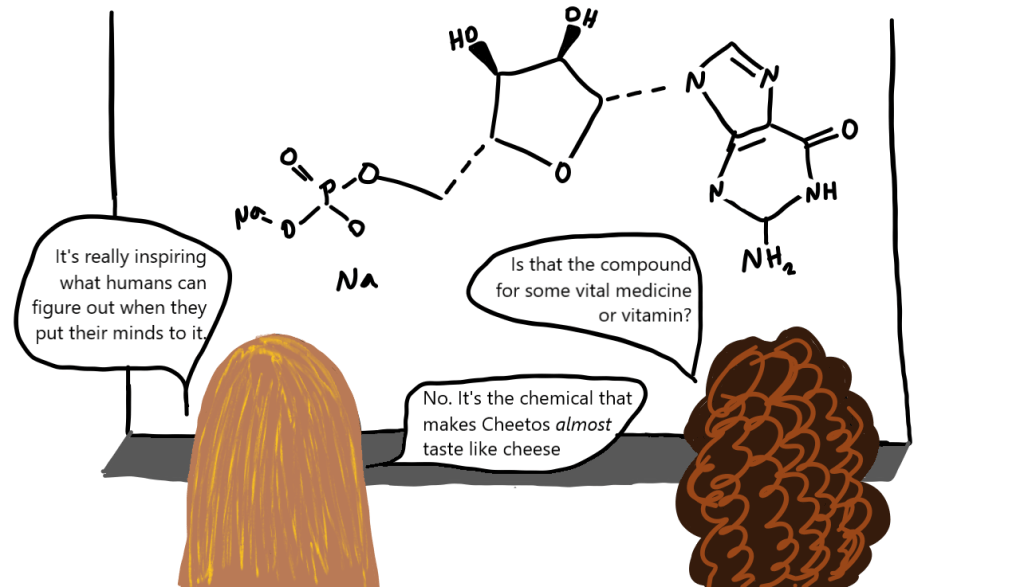
Still, since then, I’ve mostly chosen to leave the food experimenting to the experts. It isn’t that I don’t appreciate the science of food. As I’ve said before, I love the precision of baking. I find it incredibly satisfying to combine the right ingredients in the right order, then watch the oven transform them into a delicious dessert – and that’s all chemistry, baby. I also like understanding why good recipes work. My favorite guide to homemade stovetop mac and cheese includes several paragraphs on why only American cheese has the perfect, noodle-clinging viscosity.
But, back when I was making weekly meals for friends, I didn’t want to gamble time, ingredients or my reputation on any risky food hypotheses. So I only used recipes that had already been thoroughly tested and peer-reviewed. Of course, recently, I’ve been cooking more meals for just myself. I’ve also had a harder time finding the exact ingredients many recipes call for. So, I’m deviating from my trusted recipes more and more – picking up where I left off in middle school as an explorer of the culinary sciences.
What follows are some notes from a few of my recent recent kitchen experiments. As you will see, not all of them had favorable results – but that’s the beauty of science. Even when a hypothesis is proven incorrect, we still learn something. At least, that’s what my seventh grade science teacher said when she gave me that B+…
Experiment 1: Strawberry Strudel
Hypothesis: I already have the knowledge and the technology to create a successful strudel filling out of strawberries and cream cheese.
Background
The sponsor who funds the Sprinkle Fix satellite lab in Minnesota – i.e. my mother – was intrigued by the strudel recipe I posted recently. She requested that I make one for her. She also has interests in both Big Strawberry and Little Cream Cheese – i.e. she got five pounds of strawberries from a nearby berry farm offering curbside pickup, and she had 3/4 of a brick of cream cheese starting to turn gray in her fridge.
I was unable to find a recipe for strawberry cream cheese strudel made the traditional Austrian way. So, after an extended period of research, I constructed one of my own. As the lab’s foremost strudel expert, I see no reason why it won’t work.
Process notes
Phase 1: Make dough and fillings
Early results are promising. Both the cream cheese mixture and the strawberry compote taste good on their own, so it stands to reason they will taste good together. The dough is also much softer and easier to work with than it was the last time. What could go wrong now?
Phase 2: Shape and fill dough
Something has gone wrong. Phase two began by building upon the momentum of phase one. The dough stretched paper thin with little tearing. I also managed to add all the very wet filling and roll the whole thing into a log with the aid of a cotton dish towel and an innovative, “lift and flop” technique. Then, I got cocky.
Once the log was rolled, I thought it was upside down so I flipped it over. But then I thought it had actually been right the first time, so I tried to flip it over again. Then, it was impossible to tell whether the strawberry or the cream cheese layer was on the bottom, but the seam was on top, so I tried to flip it one last time. Only on the last flip, the log flopped halfway off the table. I caught it as fast as I could and deposited the handfuls of dough and pink slime back onto my workspace. But the damage was already done. The dough had stretched and torn, and the filling was threatening to bulge through the thin spots. The whole thing looked unsettlingly intestine-like.
I tried to retain a detached, objective demeanor as I nudged it towar more appetizing shape. However, my mom somehow intuited that things had taken a turn – i.e. she heard my heavy sighs from about three rooms away. She came in to view my progress, and I admitted that it was probably going to be a disaster. But, it was time to cut my losses and just put it in the oven. I asked her how long she thought I should bake it.
“Well,” she asked, “what does the recipe say?”
At this point, I had to admit the truth: there was no recipe. My “research phase” had consisted of me skimming three unrelated recipes from from Smitten Kitchen, a blogger called CakeWhiz, and a Pillsbury one that involves smashing crescent roll dough pieces together and then adding Smuckers jelly. The confidence I’d displayed before I started was completely unearned.
I was making the Theranos of pastries.
Phase 3: Bake
As I expected, things went from bad to worse in the oven. The strawberry filling started leaking out of the pastry right away, and it didn’t stop until the strudel was completely deflated and drowning in a pool of red goo. It looked kind of like the cheese-moeba I created during my first strudel attempt in Ireland – only murdered.

I took it out of the oven with my shoulders slumped. I apologized to my mom for sinking her resources into this futile experiment. She shrugged.
“Eh, I bet it will still taste good with ice cream,” she said.
I mean, she was right – but I still feel ashamed.
Results and analysis:
My hypothesis was wrong. If I ever attempt this recipe again, I will make a thicker strawberry filling and handle the finished roll as little as possible. But, I’ll have to wait until my pastry amnesia sets in again, and I forget how annoying it is to make strudel. If history is any indication, this could take anywhere between five months and eight years.
Experiment 2: Sourdough Bread (Revisited)
Hypothesis: I have been over-fermenting my bread dough
Background
I have baked sourdough bread almost every week since Easter. All the loaves have been tasty, but kind of flat and homely. Then, one day, I clicked on an instructional YouTube video by the “Regular Chef” that promised to help me and my sourdough achieve better “oven spring.” About two thirds of the way through the video, the Regular Chef revealed the biggest mistake he made when he first “got into sourdough”: Over-fermentation. He explained that if sourdough rises for too long, the yeast will have used up its leavening mojo by the time it gets to the oven. “It causes your dough to become really wet and sticky,” he said, poking a blob of lifeless dough.
I gasped and leaned in. It was exactly what my dough usually looked like. The camera jumped closer to the Regular Chef’s face – expressionless except for one raised eyebrow. “I know it’s tempting to extend the bulk rise phase as you see your dough getting lighter and airier,” he said. I nodded, feeling seen. I thought, You’re right, Regular Chef. All this time I thought a long bulk rise was the key. But maybe it’s what has been holding me back.
Process notes
Trial 1
The first trial took place in my satellite lab in Minnesota. I followed the Regular Chef’s recipe to the letter. Instead of letting the dough rise for eight-plus hours, I only let it rise for about two-and-a-half hours. I also folded it every half-hour instead of every hour. It wasn’t difficult, but it did cause some angst when it was time for my mom and I to go for a hike at nearby state park. We had to leave before 3 p.m., but I was worried about abandoning my dough.
“Well,” my mom said, “would you rather go outside and get some truly fresh air for the first time in five months, or stay inside and watch your dough?”
I thought about it very hard – even though my brain was already overtired from all the science I was doing – and said, “um…I feel like you’re implying that the dough…would be the wrong choice…right?”
In the end it turned out fine. I read the recipe more carefully and discovered that the dough had to rest in the fridge three to 12 hours anyway. The trial – and the hike – proceeded as planned.
That evening, I preheated the oven to 500 degrees, then placed the first of two loaves in a dutch oven with the lid on. After 20 minutes, I pulled the crock out of the oven, held my breath and lifted the lid. Inside, I found the stateliest loaf of bread I have ever seen outside of a bakery. Giddy with excitement, I put it back in the oven to brown. By the end of the baking process, I had two tall, golden, gorgeous loaves of sourdough bread.
I processed into the living room, carrying them on their cooling rack and glowing like I had just been awarded the grand prize in a loaf pageant.
“Behold!” I commanded my mother.
“Oh wow,” she said, “those look very nice.”
“No,” I said, “They’re perfect. I feel like a bread princess.”
Trials 2 and 3
In a rare move for the Sprinkle Fix Lab, I have repeated the procedure. And in two subsequent trials, I have gotten the same impressive results. 100 percent of poll respondents* agree: the bread is delicious.
*Survey sample includes me; assorted close friends and family members; at least one cat, who gnawed chunks out of a loaf that was cooling overnight; and the dog, who just wanted to see if it lived up to the hype.
Trial 4
I returned to my Illinois lab for the fourth trial. Once again, I followed the Regular Chef’s recipe to the letter. But this time, when I took the lid off the dutch oven, I was disappointed. The dough spread out more than up, creating a wide, flat circle. It still rose a little – It just didn’t hit the heights I now know are possible.
Results and analysis
Findings are inconclusive. I do not have enough data to isolate the determining factor in proper oven spring. Too many variables changed during my Illinois lab trial: I mixed the dough in an un-air conditioned kitchen, shaped it on a stickier counter, and baked it in a crummier, electric oven. It’s also possible that Minnesota’s wild yeast microbes are just naturally cooperative and the ones in Illinois are dicks. I know I can’t prove that, scientifically. But, I also can’t disprove it…
Experiment 3: The Ultimate Red Velvet Cake
Hypothesis: Varied cream-cheese-based elements will improve the overall red velvet experience.
Background
My sister celebrated her birthday at the end of July with a small, outdoor gathering in Northern Minnesota. Naturally, I asked her what kind of cake she wanted. She requested red velvet. She even gave me permission to riff a little – as long as I didn’t get too weird. I decided to make a red velvet cake with an actual cheesecake layer in the middle and a cream cheese whipped topping. I figured this would provide a fun baking challenge for me, while still staying true to the classic red velvet cake flavors.
Reader, if the phrase “fun baking challenge” didn’t immediately make you go, uh oh…, you must be new here.
Process notes
Phase 1: Bake cheesecake
Early results are promising. I took the cheesecake layer out of the oven while it still had just the right amount of wobble. It appears to have baked evenly, with a smooth, glossy surface. I anticipated that this would be the most challenging phase of the project. Literally nothing can go wrong now!
Phase 2: Bake cake
Something has gone wrong. Everything seemed normal when I put the cake layers in the oven. And there were no red flags then I took them out. They sprang back when I touched them and passed the toothpick test. But when I flipped them out of their pans to finish cooling, I saw that one layer was dark and gummy on the bottom – like it hadn’t baked all the way through.
I paced between the dining room and the kitchen, trying to figure out how I screwed up baking a simple cake – something I have known how to do since before I was allowed to play with silly-putty, unsupervised. My mom offered me some comfort and then a paring knife. “Just cut the raw part out and cover it with frosting” she said. “That always worked when you were kids.”
“I guess I’ll have to,” I sighed. “It’s just that I’m supposed to be good at this.”
“Hey, yeah!” she said, “You’re supposed to be Cakegirl!”
Once again, my shoulders slumped in shame.
Phase 3: Whip topping
To make the topping, I started whipping all the ingredients together, looking for “stiff peaks.” But the mixture went straight from soft peaks to the consistency of wet cement. I suspected the cream was starting to break. I did some quick googling to see if there was any way to save it. Several sources suggested adding more whipping cream – but I was all out.
I became despondent. My mom offered a few suggestions, which I rejected. Eventually, she left me to my wallowing. I had a little bit of cream cheese left, so I mixed up a batch of cream cheese buttercream frosting. I knew it would be too sweet and heavy for the cake, but I was out of other options.
The next day, I woke up still sad about the cake – and embarrassed that my mom was there to witness the depth of my despair. As a rule, I try to shield normal people from the reality of what it’s like to have a pastry-based sense of self worth. It can get dark.
As we were packing up the car, my aunt texted my mom to say she was going to the store before the party. Did we want to add anything to her shopping list? Immediately I asked, “can she get whipping cream?”
Results and analysis
Despite multiple errors in the procedure, I was still able to prove my hypothesis correct. My aunt did get me more whipped cream. When I got to the party location, I mixed it into a new topping with satisfactorily stiff peaks. I stacked the cheesecake layer in between the two cake layers, covered them with swirls of whipped topping, and added some fuchsia flowers from my mom’s garden for decoration.
The finished product was spectacular. The rich cheesecake filling, the super tender cake and the light whipped frosting all complemented one another perfectly. The birthday girl and all of her guests loved it. And my mom even got rid of the first batch of broken topping by marketing it as fruit dip.
Off the record: Cakegirl’s reputation is intact. But it’s probably best that she continues to work alone.
Experiment 4: The Rhubarb Lab
Hypothesis: Rhubarb and custard have not yet reached their full, dessert potential
Overview
A few weeks ago, I had a surplus of rhubarb and I felt like trying something new. I hadn’t promised baked goods to anyone, and there was no ticking clock. I was only limited by my own imagination. I started with strawberry Rhubarb pop tarts and rhubarb muffins with a custard filling. The pop tarts were good but not very innovative. And the results of the muffin trial were tasty, but not publishable. The custard filling deflated in the oven, leaving big holes in the middles of the baked muffins. But after that, I had lots of extra strawberry rhubarb compote from the pop tarts and custard filling from the muffins. So, I decided to layer and freeze the two in popsicle molds. Those results were flawless – a true leap forward in rhubarb/custard technology. That recipe is available on the next page.
In summary, my seventh grade science teacher was right. Even though most of my hypotheses haven’t held up, I have learned a lot in the Sprinkle Fix lab – like that my sovereignty as bread princess extends only as far as the West side of the Mississippi; that you have to whip cream cheese and heavy whipping cream separately before you mix them together; and that no good can from playing Strudel God. Most importantly, I’ve learned that it’s OK to try new things in the kitchen, even when you aren’t sure how they’ll turn out. Sometimes, the freedom to fail leads to true innovation. And the rest of the time, the results are usually still pretty good with ice cream.
 Sprinkle Fix
I have to know, which cat is the sourdough fan?!?
Also those popsicles look amazing!
LikeLike
We suspect Walter. But we also wouldn’t put it past all the animals to do an Ocean’s 11-style team-up of uneasy allies to pull off a grand bread heist.
LikeLike
Glad I was there for the birthday cake. It was fantastic. I didn’t taste the bread but it could have been on display in a bakery window.
LikeLike