Jump to the recipe for butternut squash pierogies
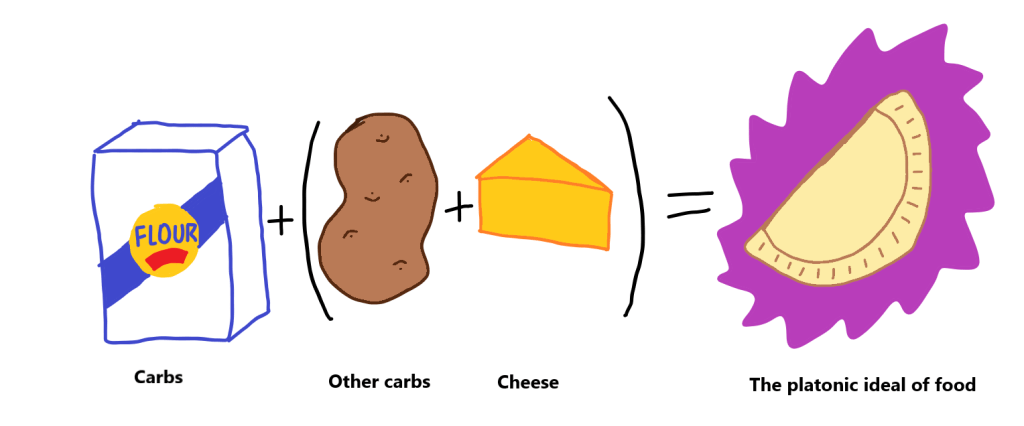
For a long time, I thought pierogies and I were fated to be together – That something in my blood calls out to this sacred food of my motherland. That’s been my go-to explanation for why I keep finding myself with a rolling pin in my hand and mashed russets in my hair at 2 a.m., swearing I will never do this to myself again. But the pierogies know I’m bluffing. The following year, in the thick of winter, I will hear their siren song again and I will begin the cycle anew. It’s like Hades and Persephone – you know, if Persephone was a Midwestern lady with a thing for sparkly eyeshadow, and Hades was a hot ball of dough and cheese.
Or at least, that’s how I’ve framed it in the past. Pierogies have a unique place in my heart, but I’ve come to realize that fate doesn’t have much to do with it. The truth is a little more complicated and a lot less interesting. If you don’t think that sounds like compelling blog material, you’re probably right. But what choice do we have? We’re in the middle of a pandemic and I know for a fact that you blazed through all of Love is Blind weeks ago. So, grab a bowl of your favorite beige food and get comfortable. It’s time to get to the root of my dumpling issues.
Origins
Pierogies were a regular part of the weeknight meal rotation when I was growing up. Our “family recipe” was the blue box of Mrs. T’s potato and cheddar flavor from the Cub freezer aisle. My mom would dump them into a pot of boiling water, then scoop them straight into a serving dish. We would pile them onto our plates along with microwaved frozen peas, low-fat cottage cheese and sliced onions that had been drowned into limp submission in several tablespoons of butter.
For a long time, I thought pierogi-making was something people only did by hand in the olden days – like churning butter or math. My mom never made pierogies for us from scratch. She told us about about how she and a friend had made them once in her dorm kitchen in college, using a wine bottle as a rolling pin. But by the time she had three kids, she did not have the time or patience to stuff mashed potatoes into tiny dough pockets. Still, my mom made sure we understood that pierogies were a special part of our heritage.
My mom’s father is the son of Ukrainian immigrants. She told stories about her grandmother and her aunts pinching dozens and dozens of dumplings together for the family feast at Epiphany (or as she called it, Ukrainian Christmas). For less special occasions, there was “lazy pierogi,” which was just the dough, sliced into strips and boiled like Baltic pasta. It was served, of course, with butter.
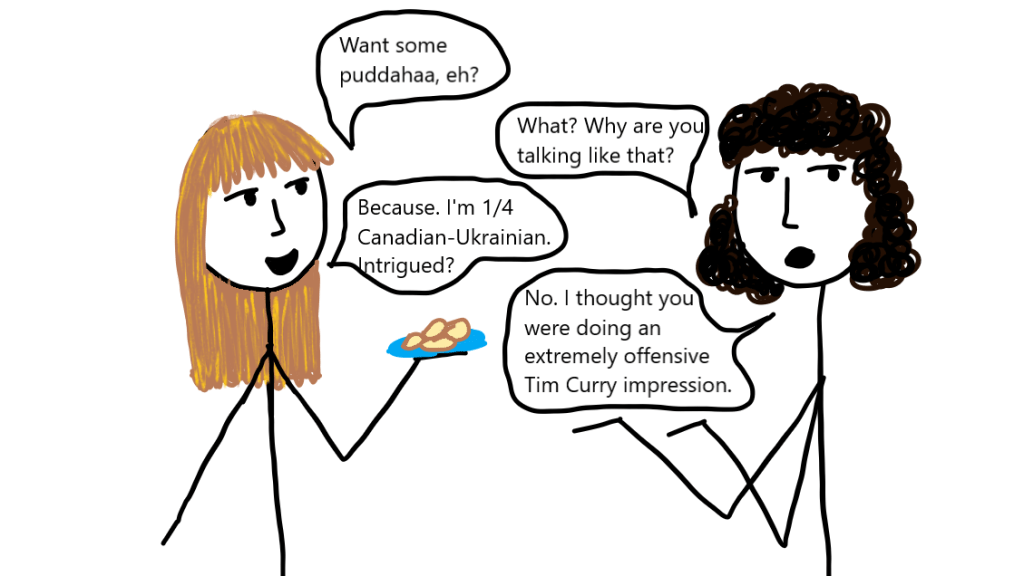
Instead of calling them “pierogies” like it said on the blue box, my mom coached me and my siblings to call them “puddahaa.” Sorry, I have no idea how to spell that because it’s a collection of sounds that doesn’t exist in the English language…or any language, as it turns out. I was told it was the Ukrainian word for “pierogi,” but I have since learned that it’s actually gibberish that emerged at the wrong end of a game of inter-generational telephone. It probably started out as something like “pyrohy.” I did not do this fact check until well into adulthood though. I proudly told all my childhood friends about the special Ukrainian name my family had for pierogies in an attempt to seem interesting.
It isn’t just my family creating creating pierogi lore – The dish is surrounded by a rich, strange mythology that spans centuries. “Ukrainian-foods.com” claims that my Ukrainian ancestors sacrificed cheese pierogies during the young moon, near the source of spring water. Other cultural groups have stories about explorers, warriors and saints bringing pierogies to the masses. The true origins of the pierogi are ancient and unknowable though – the tradition of wrapping carbs in other carbs appears to be as old as civilization itself.
I didn’t know about any of this until recently, but it makes sense to me. My experience has taught me that, across time, space and cultural divides, dumplings unite us all.
Making the Myth
When I met my best friend Anne in college, pierogies were one of the first things we bonded over. She told me about how her Polish grandmother had taught her how to make them, and I shared my family’s Ukrainian tradition. (I might have downplayed Mrs. T’s role in my childhood.) We agreed that we were obviously fated to make a pierogi feast together. So, we talked to the leaders of the Christian fellowship club we were part of, and got the go ahead to cook our first meal for the group.
You guys know that scene in Harry Potter and the Sorcerer’s Stone where Harry and Ron save Hermione from a troll? It has a line about how people can’t help but be friends after they’ve gone through certain intense experiences together. I think that’s what happened with Anne and me. Except, instead of facing down a 12-foot mountain troll in the halls of Hogwarts, we bonded over a pile of sticky dough circles in a communal dorm kitchen at 3 am. By midnight that night, when we were not yet half-way through the stuffing and folding process, we knew we’d made a mistake. But there was nothing to do except keep going and become friends for life.
The meal was a success in the end. Still, when Anne and I finally sat down to eat, with aching feet and dark circles under our eyes, we agreed that it hadn’t been worth it. We vowed to never attempt to make pierogies for 30 by hand ever again.
We then did it again the next year. Also the year after that.
For subsequent pierogi feasts, we rounded up more volunteers to lighten the workload. Somehow though, we always stayed up just as late. The only difference was that more people suffered with us. One charming soprano from our a capella group recruited two guys we had never met before to help assemble the dumplings. They sat shoulder to shoulder, stuffing dough for hours. We told them several times it was OK for them to quit. “No,” they said with the blank expressions of new members of the Borg hive, “we’re having fun.” Finally, at around 2 am we told them, “you have to go home. You’ve been super helpful, but your dead eyes are scaring us.”
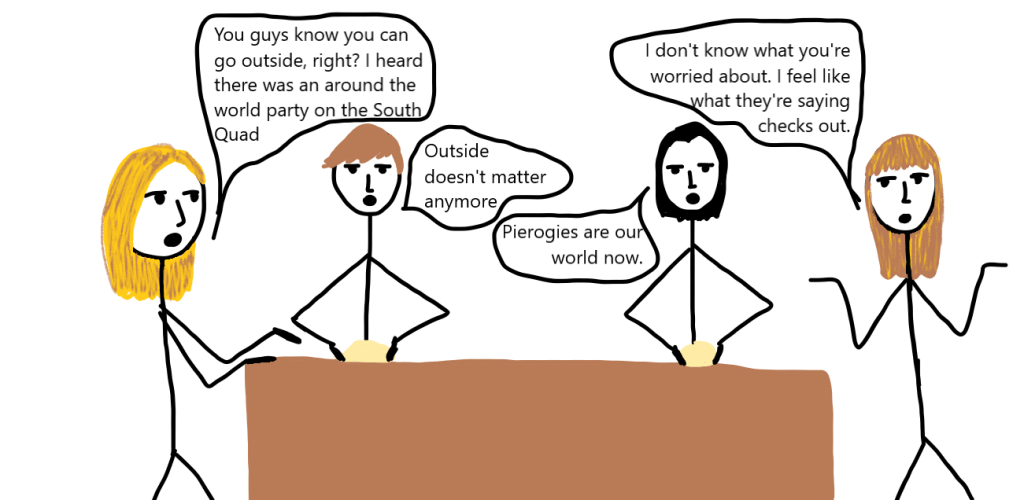
Anne and I were glad we finally convinced them to leave, but part of me wasn’t surprised that they wanted to stay. That’s the power of pierogies – once they get a grip on you, it’s hard to shake yourself loose.
A New Narrative
I still undertake a massive pierogi-making project about once a winter. Often, it’s when Anne comes to visit. Last year, I invited about a dozen people to my apartment for a pierogi-making party. This year, I got elbow-deep in dough alone in my apartment, a few weeks into the COVID crisis. I ended up with a dozen pierogies for myself and a few dozen for the doorsteps of a couple friends.
Like I said, I used to think I was bound to the dish itself through a mix of genetics and destiny. I don’t believe that any more. No one in my family actually handed the pierogi-making process down to me. I figured it out on my own. The truth is that I was drawn to it because I like most long, involved cooking challenges. And I was drawn to Anne because she likes them too – not because our ancestors scythed wheat on opposite sides of the same sea. The recipe I use is also devoid of any ancestral magic. I once had my Grandma show me the handwritten note card with her recipe for pierogi dough. I used that recipe a couple of times, but then I switched to the King Arthur Flour recipe. Sure, my family recipe may be able to harness the power of the young moon – but the KAF one’s got both butter and sour cream in it.
I do still dip into a well of cultural knowledge when I make pierogies – just in a different way than I used to think. Many people assume that pierogies were weeknight meals for peasants, since they’re made from plain, cheap ingredients. Actually though, they have always been food for special occasions. So maybe my ancestors started with the staples they had on hand. But once they applied their ingenuity and a few hours of monotonous labor, they came up with a high-holiday feast.
Generations later, that same persevering spirit led my mom to her college dorm kitchen with a bag of flour and a wine bottle for a rolling pin. And on my good days, I like think she handed it down to me. A few weeks ago – when I made squash scraps and leftover goat cheese into a meal fit for kings, queens and my socially distant friends – that’s the tradition I called on.
The recipe for those very non-traditional peirogies is on the next page. If you want a nice long project, or a way to punish yourself in the kitchen – or both! – click on through.
 Sprinkle Fix