I’ve always romanticized bread baking. The process has been handed down through generations of prairie women. My mother taught me how to knead dough by hand when I was little, the same way her mother taught her: fold, shove, quarter turn, repeat. The first time I decided to make bread on my own as a young adult, I pictured myself with my nose adorably smudged with flour, filling my home with the smell of fresh bread and the pride of my ancestors.
In reality, I ended up slumped over the counter with flour smeared in many non-cute places. And I knew that if my ancestors could see my misshapen handiwork they’d be like, “I don’t know her.”

Over the years, bread baking has gotten easier for me – not because I’ve mastered the techniques of my ancestors, but because I’ve gotten better equipment. I have a fancy thermometer that tells me exactly when my bread is done baking, and my stand mixer has taken over the work of kneading. Homemade loaves of sandwich bread, focaccias and rolls have all made satisfying weekend projects.
But then a few weeks ago – and maybe you folks have heard about this – a global pandemic cancelled all of humanity’s plans. In the absence of literally anything else to do, many people decided to fill their time by baking bread. Which meant that yeast – like toilet paper, face masks and jigsaw puzzles – suddenly became very hard to find. So, I finally caved to an alternative bread-leavening method that I’ve been resisting for years: sourdough starter.
Instead of using commercial “farmed” yeast, sourdough is leavened with wild yeast. It was likely the first kind of bread ever made. Some ancient Egyptian lunatic probably left some wet grains out in the sun until they were foamy and said, “let’s put this in the ol’ firepit and see what happens!” Incredibly, it turned out to be food – and the human race hasn’t stopped baking sourdough bread since. Early American settlers traveled from town to town with tins of sourdough starter in their backpacks for making bread, biscuits and flapjacks. In Alaska, Klondike miners snuggled with their starters at night to keep them from freezing. Today, some families are baking with starters that have been handed down through generations for over a hundred years. Of course, me and all of the other millenials who have recently taken up wild yeast-rearing do not have 100-year-old starters. What we do have is ample time and nothing to lose.
In my pre-pandemic life, sourdough baking seemed too unruly. Usually, I like baking because it is precise. If you follow a good recipe exactly, you will be rewarded with something delicious at the end. Sourdough, on the other hand, is all touch, feel and intuition. Each step takes between 12 hours and 7 days – the dough decides when you get to move on. And at the end of the whole process, there’s no guarantee you’re going to end up with an edible product. But a few days into the pandemic, I realized it was sourdough or no dough – so my winding journey began.
There’s no recipe this week. Instead, I will provide you with a detailed diary of my sourdough building process. How will it end? As I write this sentence, I legitimately do not know
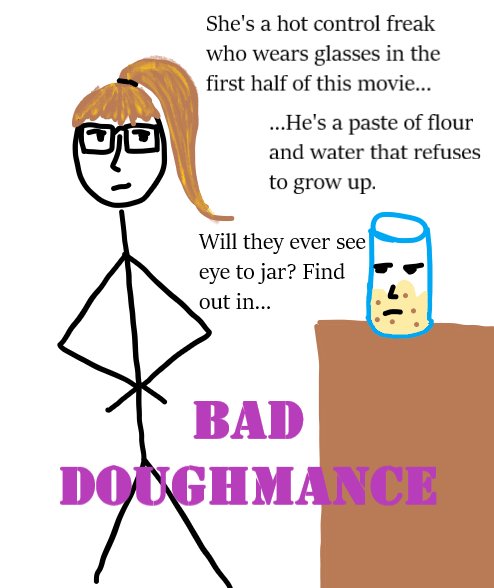
Day 1
Approximately 24 hours into Illinois’ shelter in place order, I took a trip to Aldi and couldn’t find any yeast. I decided the universe was telling me to make sourdough. When I Googled instructions for mixing up a starter, I discovered that the universe had simultaneously delivered the same message to many many other people. I wouldn’t have thought that, after being hurled into a deadly global health crisis, humanity’s next step would be: ferment dough. But, here we are.
I found a popular recipe that called for white flour and pineapple juice. I had one of those things. So, I mixed up a couple ounces of flour and Trader Joe’s orange peach mango juice in a souvenir Bacardi glass. Then, I covered it in cling wrap and set it on top of the fridge – Just like the ancient Egyptians used to do, more or less.
Day 3
Today, I added another ounce of flour and an ounce of orange peach mango juice. There are no signs of life. I’m beginning to suspect that sourdough is an elaborate prank by Big Flour
Day 4
Something is definitely happening to my starter! Bubbles are appearing on the surface which is probably good? I’m supposed to feed it in 1-4 days when it’s “foamy,” so I think I’ll give it another day just to be safe.
Day 5
I’ve ruined everything.
Today when I woke up, my first, second and fourth through 485th thoughts were about the global pandemic. But my third thought was: what if I waited to long and missed my window to feed my starter???
The bubbles are gone now, and it’s separated into a clear layer on top of an opaque layer. I transferred it to a larger bowl and fed it anyway. Will write again with memorial details when I decide to inevitably pull the plug.
Day 7
The starter might not be dead – but I don’t know if it’s fully alive either. I’m seeing some bubbles on the top. It definitely hasn’t “doubled in bulk” like it’s supposed to, though.
Step two of the recipe I was using called for 12 cups of flour – that seemed suspect, so I jumped ship and started researching other methods. I’ve learned that every sourdough person has a slightly different way of cultivating starter, and every sourdough person is convinced that their method is the only correct one. It’s like reading parenting blogs, only the stakes are about one zillionth as high. In the end, I settled on the quantities of the King Arthur Flour recipe combined with the Splendid Table technique.
Days 8-11
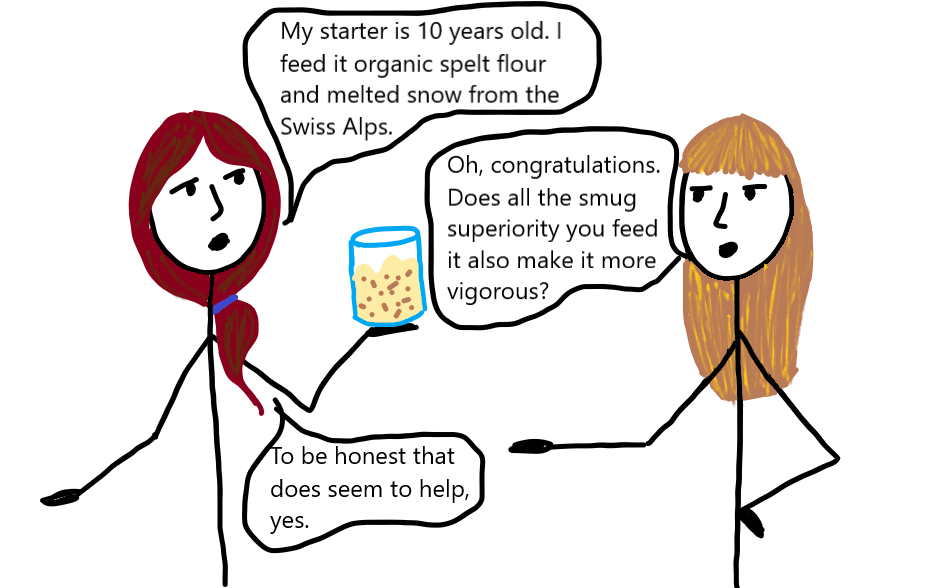
For the past few days, I have fed the starter once every 24-48 hours. To do this, I measure 4 ounces of starter into a clean container and throw the rest of the starter away. Then I mix in 1 cup flour and 1/2 cup water. My kitchen is starting to smell like the dumpster behind a brewery, and I am beginning to resent this the starter for all the attention it requires. Apparently I have lived alone for too long to even share my space with a jar of wild yeast.
Also, I’ve probably ruined everything.
Day 12
It lives! Now, after I feed the starter, it bubbles almost all the way up to the top of the mason jar. It smells kind of like beer mixed with wet paint, but who cares? I have successfully domesticated a jar full of living, wild yeast. I am queen of the microbes. After a couple more feedings, my starter will be ready to hibernate in the fridge.
Day 16
I’ve ruined everything. Even though my starter is in the fridge I have continued to reread the same three sourdough starter recipes. Now I’m worried I put it in the fridge before it was mature enough. What if I left my child starter in the tundra to die???
Nothing to do now but stay the course and hope she’s strong enough to make it through.
Day 19
Here goes nothing – I’m finally going to see if I can use my starter to bake a loaf of sourdough bread. I checked King Arthur Flour for a recipe first, but its recipe for “rustic sourdough” called for a bunch of commercial yeast as a safety net. Hey, King Arthur flour? I wouldn’t be trying to make bread out of germs from the air in my kitchen if I was a freaking COWARD. Luckily, the Splendid Table has a yeast-free “almost no knead” sourdough recipe for non-wusses.
Yesterday, I fed my starter and kept it at room temperature for a few hours. It came bubbling back to life, which seemed like a good sign. This morning, I mixed it in with all the rest of the ingredients the recipe called for and set the dough aside to rise for 12-18 hours.
Day 20
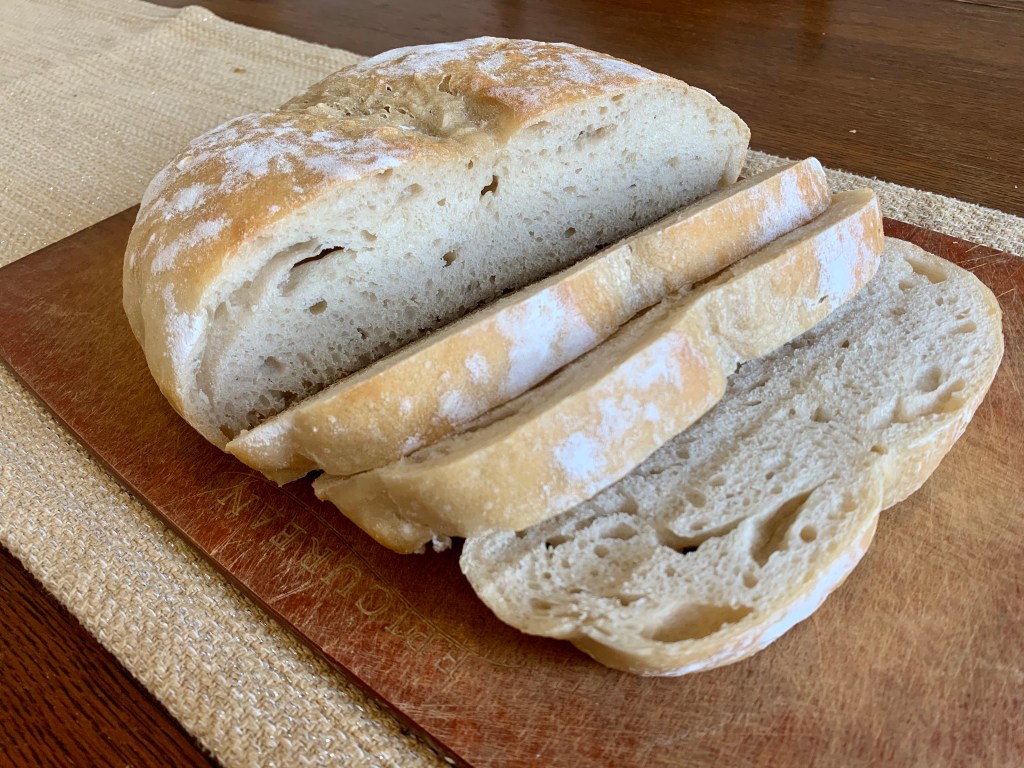
It’s an Easter miracle! Late last night I shaped and baked the dough, and now I have a loaf of something that smells, tastes and looks like bread! Admittedly, it’s not as shapely or golden as the loaf in the Splendid Table picture, but it is 100% edible – which is enough for me to declare this my most shocking baking success to date. I am already thinking about all the loaves, rolls, biscuits and cakes I can make with this starter for decades to come. So, get ready for Sourdough Diaries parts two through 11 because this is my life now I guess.
In all honesty, I understand that our national fascination with sourdough bread will probably disappear as soon as a single Dave and Busters opens its doors again. We will forget about our starters in the backs of our fridges as they wither and die. But I like to imagine a future where we keep them going and keep baking bread even after commercial yeast is readily accessible again. And one day, we will hand our coronavirus starters starters down to our children. When they wrinkle their noses and say, “what’s this?” we’ll say, “It’s food from a global pandemic. Can’t you tell?” And they’ll complain about having to feed this diseased dough once a week for the rest of their lives, but they’ll do it anyway. Then, their children will do it after them. Maybe they’ll even get a little romantic about it eventually. Because right now, we are baking sourdough for our health, sanity and survival. But hopefully someday, it will just be tradition.
Like I said, there’s no recipe on the next page this week. I couldn’t distill my disorganized “process” into a recreatable template. But if you want to try your hand at sourdough yourself, here are the sources I consulted:
Starter instructions:
Sourdough bread recipes:
 Sprinkle Fix
Caitlin! I am making sourdough bread RIGHT NOW (so it will be ready in about 1-3 days). I luckily got a starter from someone so that simplified things. I’m very impressed by your peach-mango-orange starter.
I made sourdough pancakes yesterday morning (using the King Arthur Flour recipe) and they turned out pretty good, and definitely less time consuming than bread.
LikeLike
Update: my first attempt did not go well, but the great thing about sourdough is that you can’t just decide “Oh well, not for me” like a coward, because there is a sourdough starter mocking you in the fridge. I made the Splendid Table recipe today and it turned out great! I feel very accomplished.
LikeLike